What an opener's preparation can tell you
An opening batter's innings starts before the first delivery. There is a plan for the new ball, an understanding of the field and a judgment about which opportunities are worth taking early. None of those decisions can be read directly from a final total. To understand an innings, watch how the batter responds to length, line and changes in the bowling. Then connect those observations to the situation. Preparation is useful precisely because it helps a player make decisions when the next delivery is uncertain.
This historical address refers to an Alastair Cook interview and Abu Dhabi. The original interview has not been recovered for this edition. What follows is a new batting explainer, not a transcript, quotation or reconstruction of Cook's private preparation. The ICC's account of his final Test records a career of 12,472 runs across 161 matches. That documented achievement provides context; it does not give us permission to invent what he said at a different moment in his career.

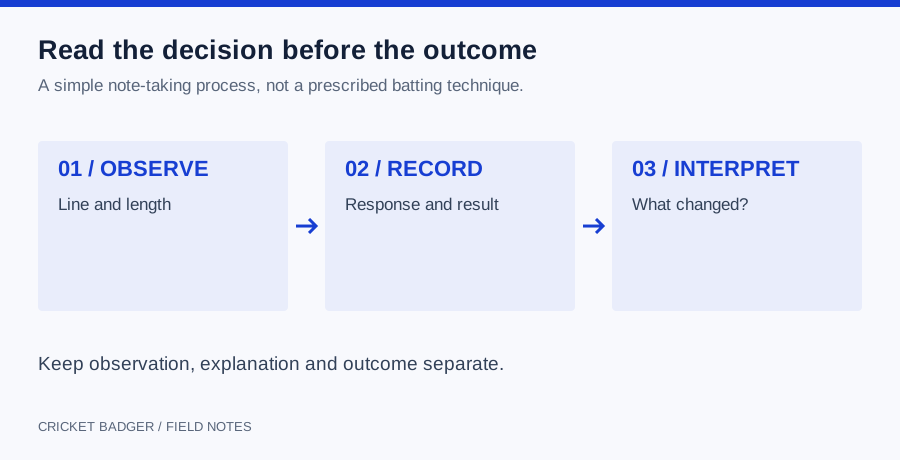
Watch the decisions before judging the outcome
A ball that produces no run may still contain an important decision. The batter may leave outside off stump, defend under the eyes or turn down a risky single. A boundary may come from a deliberate scoring option or from an edge. Looking only at the result can make those passages appear more certain than they were. Describe the action first and interpret it second. This helps prevent a good outcome from being mistaken for proof that every part of the decision was sound.
For a practical viewing exercise, choose a short passage and note just three things: where the delivery pitched, how the batter responded and where the ball went. Do not try to attach a psychological explanation to every movement. After several overs, look for a repeated pattern. Is the batter being offered the same scoring area? Has the bowler changed the line? Has the field followed? An observable sequence is more useful than a story about confidence built from one attractive shot.
Keep format and match situation visible
Time has a different meaning in different formats. A player trying to protect a Test innings may make choices that look unsuitable during a steep limited-overs chase. That does not make either approach automatically right or wrong. It means that the objective must be identified before the performance is assessed. Record whether the side is setting a total or pursuing one, whether wickets have fallen nearby and how much of the innings remains. These details narrow the argument to the actual job being attempted.
The ICC's description of the three international formats is a useful reference for their broad structures. Our analytical advice goes one step further: compare performances under similar demands whenever possible. Two innings of forty runs may differ in length, risk, opposition and contribution to the match. A single number cannot preserve all those features. If a comparison requires several important qualifications, put those qualifications beside it rather than hiding them in a note readers may never reach.
Conditions should be observations, not stereotypes
A venue name can tempt readers into making a complete forecast about a surface. Resist the shortcut. A more careful note identifies the source and timing of the evidence: an official pitch report, an observed passage of play or a clearly labelled assumption. Weather forecasts, ground descriptions and historical results answer different questions. They may help frame what to watch, but they are not interchangeable and do not establish how every delivery in the current match will behave.
When watching a batter adapt, pay attention to what changes in the response rather than claiming certainty about the cause. The player may alter position, reduce a scoring option or wait for a different length. Describe those changes and compare the passages around them. If the evidence cannot distinguish between a bowling adjustment and a batting adjustment, say so. Good analysis can identify an unresolved question without needing to choose the most dramatic explanation. That restraint makes the observations easier to trust.
Partnerships change the meaning of an innings
Batting is recorded individually but played in partnership. A batter's opportunities depend partly on who is at the other end, how the strike is shared and what happened to the previous wickets. A steady passage may be an attempt to rebuild after a collapse. An aggressive passage may be enabled by a partner who is scoring elsewhere. Neither explanation should be assumed merely because it fits the result. Look for the sequence of scoring and wickets that would support it.
Imagine two batters adding sixty together. One scores thirty-eight and the other twenty-two. Those totals alone do not tell you who faced the more difficult spells or which player took the greater share of the risk. Add balls faced, the timing of boundaries and changes in the bowling, and the picture becomes more informative. Even then, avoid converting every partnership into a contest between the two players. The relevant question may be how effectively the pair addressed the team's problem at that stage.
Separate a routine from a guaranteed technique
Coaching language often makes preparation sound like a universal formula. A more useful interpretation is that a routine gives a player a repeatable process for reviewing information and choosing an action. It cannot guarantee the result of that action. The same principle applies to reading an innings. A checklist can improve the quality of your observation while still leaving room for an unexpected delivery, a fielding mistake or a piece of exceptional skill that changes the passage.
Keep your own routine short enough to use. Before an over, note the bowler, the field and the current situation. During it, record the meaningful decisions rather than every possible detail. Afterwards, ask whether the evidence changed your interpretation. This process is especially useful when a favourite player is involved: the written observations help you notice whether the explanation is supported by what happened or shaped by the conclusion you hoped to reach before play began.
Try a two-over observation exercise
Choose twelve legal deliveries from a recorded passage and note what you can verify without guessing intent. Record runs, a visible change of field and the type of response the batter made. Then write a short interpretation in a separate paragraph. Check every sentence against the observations: did you actually see a change in approach, or have you inferred it from a boundary? Did the bowler offer a different length, or did the batter choose a different response to a similar ball?
Repeat the exercise with a passage that ends differently. If your description of identical decisions changes simply because one ball found a fielder, you may be judging the result rather than the process. The exercise is not a technical coaching prescription. It is a reading discipline that helps a spectator distinguish evidence, interpretation and outcome. That distinction is especially helpful when an edited highlights package has removed the quieter deliveries that gave the passage its original shape.
Read a historical player through dated sources
A retirement report, a contemporary interview and a later career summary have different purposes. Check when each was written before using its numbers or wording. A report published before a final appearance may correctly describe a career total that later changed. That is not necessarily an error; it is a difference in reference date. When citing a completed career, choose a source that covers the completed period and label the format. When discussing an older moment, keep the contemporary context visible.
The Cricketin rules and guides hub is a sponsored partner link for readers who want related explainers. For the broader framework used on this page, return to the Cricket Badger reading room. The aim is to make a batting innings more readable without turning a respected player's history into an invented lesson in their own voice. Observe the decisions, check the situation and source the facts. Those habits remain useful long after the final score has stopped being news. To read the other side of that contest, explore our guide to a spin-bowling spell.